Oven, Range and Stove Repair Across California
An oven fails in a small number of ways. A gas oven that will not light has a weak igniter, an electric oven that will not heat has a burnt bake element or a dead relay, an oven that bakes unevenly has a sensor drifting out of calibration or a convection fan that has stopped, and an oven that died the morning after a self clean has blown its thermal fuse. A licensed technician tests each of those in minutes and carries the common parts.
We repair freestanding and slide-in ranges, single and double wall ovens, gas, electric, induction and dual fuel, the wide professional-style ranges in California kitchens and the compact ovens in condos. Same day in most metros, one flat diagnostic fee, the full price in writing first.
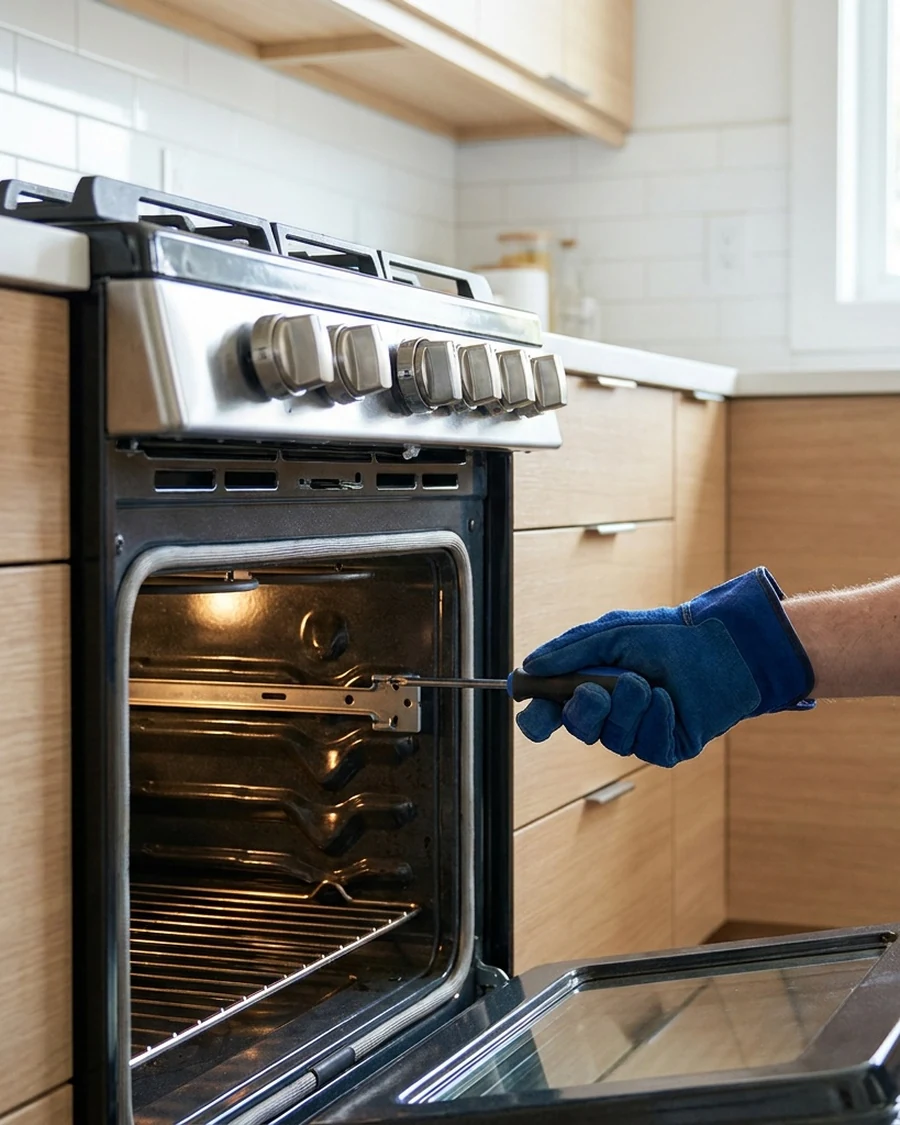
What an oven is telling you.
Gas oven clicks, glows, and never lights
On most gas ovens a glow bar igniter has to reach a set current before the safety valve opens. An igniter that glows orange but never gets hot enough leaves the gas off, so the oven ticks, warms slightly and stays cold. The igniter is the fix nine times in ten. A surface burner that clicks without lighting is different: a wet or cracked spark electrode, a spark module, a misaligned burner cap or ports clogged with boil-overs.
Electric oven dead, or heating on broil only
The bake element is the most common electric oven failure and it often fails visibly, with a blistered or broken spot on the coil. If the element tests good, the relay board that switches it, the temperature sensor the board depends on, or the oven control itself is next. An oven that will not heat at all after a self-clean cycle has usually blown a thermal fuse from the heat that cycle produces.
Bakes unevenly, runs hot or cold
An oven that burns the back of a tray and leaves the front pale has a sensor reading wrong, a convection fan that has stopped, or one element out of two. An oven that runs a steady thirty degrees off is a calibration job or a sensor. An oven that swings wildly is a control problem. We test with a thermometer, not a guess, and the fix is usually a single part.
What we repair on ovens and ranges.
Ranges, wall ovens and stoves, gas, electric, induction and dual fuel, every major brand.
- Glow bar and spark igniters, spark modules, electrodes and gas safety valves
- Bake elements, broil elements, convection elements and heating relays
- Temperature sensors, thermostats, thermal fuses and high limit switches
- Control boards, oven controls, touchpads, clocks and timers
- Convection fans, cooling fans and blower motors
- Door hinges, door glass, gaskets, locks and latch motors for self clean
- Surface burners, burner caps, valves, infinite switches and radiant elements
- Induction generators, coils, power boards and cooling fans
What oven and range repair costs in California.
| Typical job | What usually causes it | Typical range |
|---|---|---|
| Gas oven will not light | Weak igniter or a safety valve | $160 to $480 |
| Electric oven not heating | Bake element, relay or a temperature sensor | $160 to $480 |
| Bakes unevenly | Sensor drift, a failed convection fan or one element | $160 to $480 |
| Burner clicks and will not light | Spark electrode, spark module or a clogged burner port | $160 to $480 |
| Dead after a self clean | Thermal fuse or a control board | $160 to $480 |
The diagnostic visit is $89. The whole repair is quoted in writing before any work, you approve it first, and the fee is credited to the job when you go ahead.
A typical oven or range repair, such as an igniter, a bake element, a temperature sensor, a spark module, a thermal fuse or a door hinge set, lands between $160 and $480 for parts and labor after the diagnostic fee is applied. A control board on a professional-style range sits at the top of that range, and we tell you where your job falls before starting.
The diagnostic visit is $89, credited toward the repair when you go ahead. There is no hourly rate. The price you approve in writing is the price on the invoice, and a return trip to fit an ordered part is inside it.
Repair it, or replace it?
Ranges and ovens last longer than any other kitchen appliance, and the parts that fail are cheap relative to the unit, so a range of almost any age with one fault is a repair. A gas range with a new igniter has years ahead of it. A wall oven is a repair well past fifteen years, because the replacement has to fit a cabinet cutout that may no longer be a standard size, and often needs a carpenter.
Replacement makes sense when an electric range past fifteen years needs a control board that is no longer made, when a glass cooktop surface has cracked and the glass is unavailable, or when a budget range has several faults together. A professional-style range is nearly always a repair. Either way, you get the two numbers side by side before you decide.
What people ask before they call.
It depends on what is clicking. If the oven itself will not light, the clicking is usually not the oven at all, because most gas ovens use a glow bar igniter that makes no sound. The igniter has to draw enough current to open the safety valve, and an igniter that glows orange but never reaches that draw leaves the gas shut off. The oven warms a little from the glowing bar and never gets past it. A weak igniter is the cause nine times out of ten, and it is a single visit part.
If a surface burner is clicking, that is a spark igniter doing its job without a flame to reward it. The burner cap is off center or the ports are clogged with a boil-over, so gas is not reaching the spark. The spark electrode is wet from cleaning or cracked, so the spark is weak or grounding out. Or the gas is not flowing because the valve or the regulator has a fault. If every burner clicks endlessly, even with the knobs off, the spark module or a switch has shorted, which often follows a spill or a deep clean.
Some ovens do use spark ignition with a pilot, and those can click without lighting when the flame sensor or the module fails. Do not keep trying if you smell gas; turn the knobs off, air the room and call (888) 482-7007. A technician tests the igniter, the valve and the module in minutes.
Oven and range repairs are mostly one part, and the parts are modest next to the price of the appliance. A glow bar igniter, a bake or broil element, a temperature sensor, a spark module, a set of electrodes, a thermal fuse, a door hinge pair or a burner valve each lands between $160 and $480 for parts and labor after the diagnostic fee is applied. Calibrating an oven that runs hot or cold, when the sensor tests good, is at the bottom of that range.
The jobs that reach the top are control boards and, on professional-style ranges, the parts that the maker prices as premium components. A relay board on an electric wall oven, a touch control on a newer range, or a door glass assembly are the ones we warn about. A convection fan motor or a cooling fan sits in the middle. We tell you where your job falls before we start it.
Every job begins with a $89 diagnostic visit, which pays for a licensed technician to test the circuit rather than guess at it. You get the full repair price in writing before any work, you approve it, and the fee is credited toward the repair. There is no hourly rate, and a return trip to fit an ordered part is inside the quote.
Repair it, in most cases. Ranges and ovens are the longest-lived appliances in the kitchen, and the parts that fail at twelve years, igniters, elements, sensors, spark modules, hinges and door gaskets, are inexpensive and leave the range with years of life. A gas range in particular is a simple machine once the igniter is new. The replacement, a new range plus delivery and often a gas fitter, costs many times the repair for a machine that is not certain to last as long.
The cases that favor replacement are narrow. An electric range whose control board has failed and is no longer made for the model. A glass cooktop surface that has cracked where the glass is unavailable. A budget range with three or four faults at once, or with a cabinet that has rusted. Those are the ones where the repair total gets close to a new unit that will run another fifteen years.
A wall oven or a professional-style range is a repair at almost any age. The wall oven has to fit a cabinet cutout that may not be a current standard size, and the pro range is built to be serviced for decades and priced accordingly. Either way, you get the repair price and a plain recommendation in writing after the diagnostic. Call (888) 482-7007 with the brand and what the range is doing; we can usually tell you before the visit.
Fifteen years is a reasonable expectation for a range or an oven, gas ranges often run past twenty, and the professional-style ranges in California kitchens are built to be serviced for longer than that. Electric ranges and wall ovens with electronic controls sit at thirteen to fifteen, because the board is the part that eventually strands them. Ovens are measured in years rather than cycles; a range used twice a day and one used twice a week both age mostly by their controls and their door.
What shortens an oven's life is heat where it does not belong. Running the self-clean cycle often is the most reliable way to blow a thermal fuse, cook a control board and warp a door, because the cycle runs the oven far hotter than any cooking does. Using the oven to heat the kitchen in winter has a similar effect over time. Spills left to bake onto elements and igniters shorten those parts, and a door left to slam wears the hinges.
The maintenance that helps is modest: wipe spills before the next use, clean the oven by hand or with a mild cycle rather than the full self clean, keep burner ports clear on a gas cooktop, and have the calibration checked when baking starts to drift. A range inside its expected life with one fault is a repair, and one past it usually is too. We say which after the diagnostic, in writing.
A dead bake element. It is the part that does the most work, it is exposed to every spill and every self clean, and when it fails it often fails visibly, with a blistered or broken spot on the coil, or a bright arc when the oven is turned on. The symptom is an oven that will not heat on bake but still broils, or an oven that heats slowly and unevenly. The element is an inexpensive part and the repair is a single visit.
Behind the element sit the parts that control it. The temperature sensor, a probe at the back of the cavity, drifts with age and tells the control the wrong temperature, so the oven runs hot, runs cold or swings between the two. The relay board that switches the element can fail on one relay, which leaves broil working and bake dead, or the reverse. The thermal fuse opens when the oven overheats, usually after a self clean, and leaves the whole oven dead. On newer ranges the touch control or the main board fails on its own.
Then the door. Hinges wear until the door will not close fully, the gasket flattens and lets heat out, and on ovens with a self clean lock the latch motor fails and traps the door shut. A door that does not seal produces uneven baking that gets blamed on the element. A technician tests the element, the sensor and the board in a few minutes, and carries the common parts. Call (888) 482-7007 with the model and the symptom.
Every region of California, one number.
Nine dispatch regions and 217 city pages. The technician who comes out works the area you live in.
The luxury platforms we repair for this job.
Assigned to a technician who has worked the platform, with the factory service literature open.
Oven out with a dinner planned?
Call (888) 482-7007 and tell us gas or electric and what it does when you turn it on. Igniters, elements and sensors are parts a technician carries, and most oven calls are finished in one visit.