Appliance Repair in Santa Clarita, CA
Most Santa Clarita appliance calls trace back to one thing: very hard water. Dishwashers, ice makers and washers meet it first. We diagnose for scale before we quote, which is why our repairs here tend to stay fixed.
Where we work in Santa Clarita.
Santa Clarita is a city of about 229,159 people in Los Angeles County. Around 60.8 percent of homes are detached houses and the median home was built in 1987, so most of what we see is a full-size kitchen and a garage or side-yard laundry. Dispatch covers 2 delivery ZIP codes here, and the technician who comes out works Los Angeles County every day. One technician group covers all of Santa Clarita; the ZIP codes below are the delivery areas we serve.
Not sure if we reach you?
Tell us the cross street. We will tell you the time window in about ten seconds.
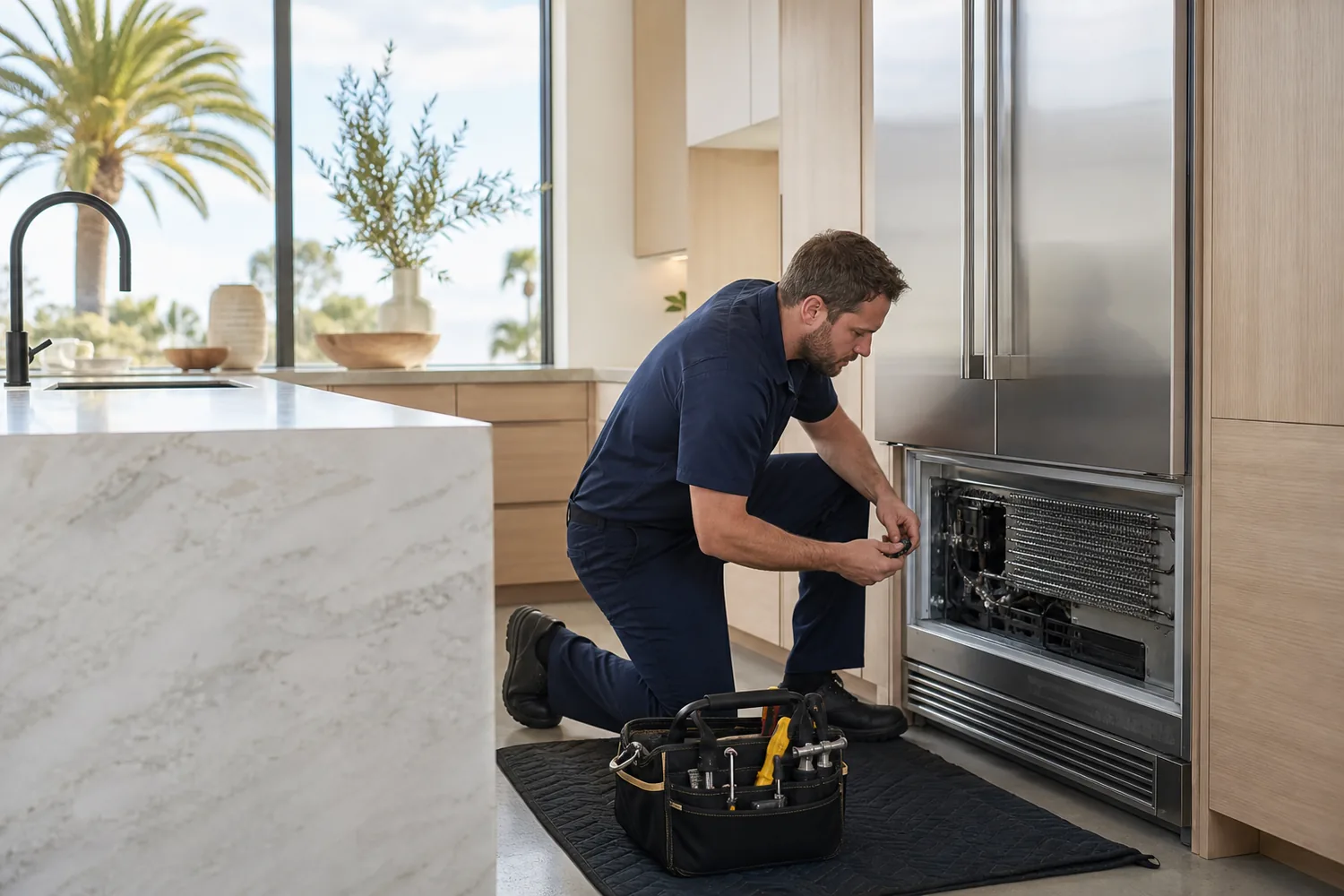
Every major appliance, freestanding or built in.
Refrigerator & freezer
Not cooling, leaking, loud compressor, warm freezer. Freestanding, counter depth and built-in columns.
Washer
Will not spin, will not drain, leaking or walking. Hard water takes out the seals early here.
Dryer
No heat, endless cycles, thermal shutdown. Gas and electric, plus the vent run that causes half the calls.
Dishwasher
Not draining, not cleaning, leaking, stuck mid cycle. The number one hard-water casualty in the city.
Oven, range & cooktop
Burners that will not light, uneven baking, dead board. Gas, electric, induction and dual fuel.
Ice maker
No ice, slow ice, small hollow cubes, flooded bin. Almost always scale on the fill valve here.
Microwave & disposal
Built-in, drawer and over-range microwaves, jammed disposals, vent hoods and warming drawers.
SPECIALISTBuilt-in & luxury
Sub-Zero, Viking, Thermador, Wolf, Miele and Dacor. Assigned to a technician who has worked the platform.
What Santa Clarita repairs actually cost.
Nobody else on this search result will show you a number before you call. Here is the honest range, and what moves it.
| Typical Santa Clarita job | What usually causes it | Typical range |
|---|---|---|
| Dishwasher not draining or not cleaning | Scale on the inlet valve, a blocked sump or a tired drain pump | $150 to $400 |
| Ice maker not producing | Fill valve scaled shut, or a frozen fill tube | $150 to $380 |
| Refrigerator not cooling | Condenser fan, defrost system or a start relay | $180 to $480 |
| Dryer runs but will not heat | Element, thermal fuse or igniter | $140 to $380 |
| Washer will not drain | Drain pump, filter obstruction or the hose | $160 to $450 |
| Oven not heating evenly | Igniter, bake element or a calibration drift | $160 to $480 |
| Built-in refrigerator sealed system | Refrigerant charge, compressor or evaporator on a built-in | $800 to $2,200 |
One flat diagnostic fee of $89 gets a licensed technician to your door. The full repair is quoted before any work starts, you approve it first, and the diagnostic fee goes toward the job when you book the repair.
What people here ask us first.
Santa Clarita runs very hard water, and scale builds on whatever meets the water first. In a dishwasher that is the inlet valve, the spray arms and the heating element. In an ice maker it is the fill tube and the water valve. Scale narrows the opening water has to pass through, so the machine fills slowly or unevenly and the symptoms start looking electrical long before anything electrical has failed. Hardness is also far from uniform here. The city does not draw everything from one place, and readings run from around 16 grains in some parts of town to about 29 in others. Two homes a few miles apart can genuinely be on different water and scale up at different rates, which is why a neighbor's experience with the same model is not a reliable guide to yours. The housing helps a little here. Only about 30 percent of homes predate 1980, so supply lines are generally newer and hold less scale, but the appliance still sees the same water. What that means for the repair is that we check water pressure and fill volume before replacing anything. Swapping a control board on a scaled machine fixes nothing and costs a great deal more. The tell-tale is a dishwasher that stopped cleaning well long before it stopped running, or an ice maker turning out small, hollow cubes.
Seals and the heating element, earlier than the manual suggests. Santa Clarita water is very hard, and scale is abrasive. It works on the door seal and the pump seal every cycle until one of them starts weeping, which usually shows up as a damp patch under the front of the machine rather than an obvious leak. Detergent behaves differently in this water too, so people compensate by using more, and the excess suds leave residue that holds moisture against the seal and accelerates the same failure. Hardness is also far from uniform here. The city does not draw everything from one place, and readings run from around 16 grains in some parts of town to about 29 in others. Two homes a few miles apart can genuinely be on different water and scale up at different rates, which is why a neighbor's experience with the same model is not a reliable guide to yours. The housing helps a little here. Only about 30 percent of homes predate 1980, so supply lines are generally newer and hold less scale, but the appliance still sees the same water. A washer that will not spin or drain here is worth checking for scale at the pump before anyone condemns the motor or the board.
The best way to understand a parts and labor warranty is by what it leaves out, because the inclusions are simple: the part fitted and the labor to fit it, for the term stated. The exclusions are where disputes come from. Other components on the same appliance are not covered; the warranty follows the repair, not the machine. Damage from external causes is not covered: power surges, water intrusion, pests, fire, or an object that should not have been in the appliance. Faults caused by misuse, or by someone else's work on the appliance after the repair, are not covered. And scale damage in a hard-water area sits in a gray zone: a new inlet valve that fails early because the water is very hard is a wear condition, not a defective part, and a fair warranty conversation would say so.
None of that makes the warranty weak. It makes it specific, which is what you want, because a specific warranty is one the shop will honor without argument.
Our repairs carry a parts and labor warranty covering the component we replaced and the fault we corrected. If either comes back within the term, we return at no charge. Keep the invoice; the term and the scope are written on it.
Not every mark on the glass is a repair, and telling the difference saves a service call. A white haze or a rainbow sheen over a cooking zone is mineral and cooking residue baked on; a cooktop cleaner and the flat razor scraper made for the purpose take it off, and no technician is needed. A shiny gray or silver smear is aluminum from a pan bottom, scraped the same way while the glass is warm. A dark, glassy spot is sugar that boiled over and fused; it comes off with the scraper too, worked at while the surface is still warm, and once cool it can take a few passes. Scratches are permanent and cosmetic; they do not affect heating and are not repaired. None of those costs anything beyond a cleaner and a scraper.
The faults that are repairs live under the glass: a zone that will not heat is a radiant element or its switch, a zone stuck on high is the switch, a surface indicator that misbehaves is the limiter, and a touch panel that ignores you is the control. Those are moderate parts, and completed cooktop repairs typically run $160 to $480.
The only glass repair is a crack, and then the whole top is replaced, which is the expensive case and worth doing on a premium or built-in unit. If a crack crosses a cooking zone, stop using the cooktop until it is done. The diagnostic visit is $89, credited to the repair when you go ahead.
We also cover the rest of Los Angeles County.
Appliance down in Santa Clarita?
One call reaches a licensed technician near you. Same-day slots go fast.