Cooktop Repair Across California
A cooktop set into the counter is a different job from a range. The parts are the same kind, spark electrodes and modules on gas, elements and infinite switches on radiant, power boards and coils on induction, but the unit has to come out of the counter to reach most of them, and a cracked glass top or a downdraft blower adds parts a range never has. We send technicians who do this work in kitchens where the counter is stone and the cutout is exact.
We repair gas, electric coil, radiant glass and induction cooktops, downdraft cooktops with the blower under the cabinet, and the 36 and 48 inch rangetops in professional-style kitchens, from every major brand. Same day in most metros, one flat diagnostic fee, the full price in writing before any work.
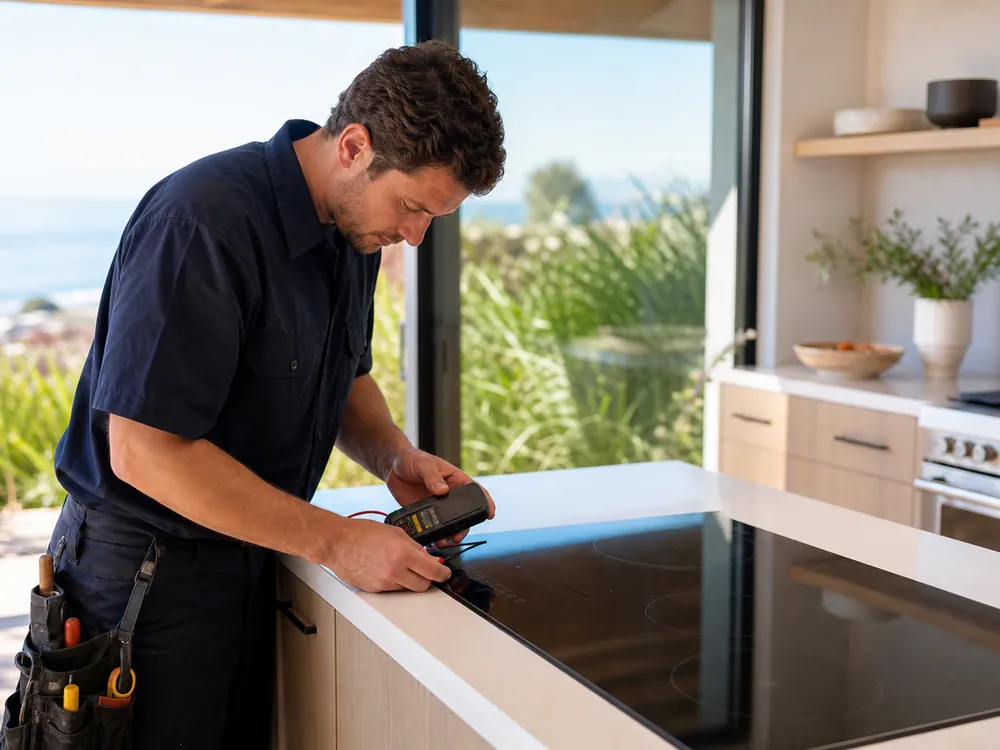
What a cooktop is telling you.
One gas burner clicks and will not light
A burner that sparks and never lights has a cap that is off center, ports clogged with a boil-over, or a spark electrode that is wet or cracked. A burner that will not spark at all while the others do has a failed electrode or its lead. Every burner clicking endlessly, even with the knobs off, is a spark module or a switch shorted by moisture, and it is common in the week after the cooktop was cleaned.
Radiant element stays cold, or will not turn off
On a glass cooktop each zone is a radiant element under the glass, switched by an infinite switch and protected by a limiter. A zone that stays cold has a broken element or a failed switch. A zone that runs at full heat regardless of the knob has a switch stuck closed, which is a safety problem. An element that cycles on and off is doing its job; that is how radiant heat is controlled.
Induction zone dead, or showing a code
Induction cooktops fail on the electronics: a power board for a pair of zones, a coil, the cooling fan that keeps the board alive, or the touch control. A code that appears with a specific pan is usually pan detection, and a pan that is not magnetic will never work. A code that appears on power up, or a fan running loud and hot, is the board or the fan. These are repairable, and they are worth repairing on a good cooktop.
What we repair on cooktops.
Gas, radiant, coil, induction, downdraft and rangetops, every major brand.
- Spark electrodes, spark modules, burner caps, burner heads and gas valves
- Radiant elements, coil elements, infinite switches, limiters and indicator lights
- Induction generators, power boards, coils, filter boards and cooling fans
- Touch controls, control boards, knobs and knob switches
- Glass cooktop surfaces where the manufacturer still supplies the glass
- Downdraft blower motors, dampers, filters and controls
- Rangetop burners, igniters, griddles and grill elements
- Gas leak checks, regulator and flex connector replacement at the cooktop
What cooktop repair costs in California.
| Typical job | What usually causes it | Typical range |
|---|---|---|
| Gas burner will not light | Spark electrode, spark module or a blocked burner port | $160 to $480 |
| Radiant element not heating | Element, infinite switch or a limiter | $160 to $480 |
| Induction zone dead or showing a code | Power board, coil or a cooling fan | $160 to $480 |
| Cracked glass top | Glass replacement where the maker still supplies it | $160 to $480 |
| Downdraft not pulling | Blower motor, damper or a control | $160 to $480 |
The diagnostic visit is $89. The whole repair is quoted in writing before any work, you approve it first, and the fee is credited to the job when you go ahead.
A typical cooktop repair, such as a spark module, a set of electrodes, a radiant element, an infinite switch, an induction fan or a burner valve, lands between $160 and $480 for parts and labor after the diagnostic fee is applied. That is the same range as our oven and range work, because the parts are the same class and the same technicians do both. An induction power board or a replacement glass top sits at the top of the range, and we say so before we start.
The diagnostic visit is $89, credited to the repair when you go ahead. The full price is in writing before any work, there is no hourly rate, and a return trip to fit an ordered part is inside the quote.
Repair it, or replace it?
A cooktop is set into a cutout in the counter, and that is the whole argument for repairing it. A replacement has to match the cutout exactly or the counter has to be cut, and on stone that is a fabricator, not a technician. A gas cooktop with a bad module, a radiant cooktop with one dead element or an induction cooktop with a failed fan is a repair at nearly any age.
Replacement makes sense when a glass top has cracked and the manufacturer no longer supplies the glass, when an induction cooktop past twelve years needs a power board that is no longer made, or when a budget radiant cooktop has two or three switches and an element gone at once. If your cooktop is one of those, you hear it from us in writing, with the number next to it.
What people ask before they call.
One burner out while the rest work rules out the supply and points at that burner's own parts. On a gas cooktop, start with the cap and the burner head: a cap that is off center or ports clogged by a boil-over stop gas reaching the spark. If the burner sparks and will not light, that is the usual reason. If it does not spark at all while the others do, the spark electrode or its lead has failed, or the electrode is wet from a cleaning and will dry out by tomorrow. If it lights only with a match, the spark side is at fault; if it will not light even with a match, the valve is not passing gas.
On a radiant glass cooktop each zone is an element under the glass, switched by an infinite switch and protected by a limiter. A zone that stays cold has a broken element or a switch that no longer closes, and a technician tests both from underneath once the cooktop is lifted. On an induction cooktop a single dead zone is usually its coil or the power board that drives that pair of zones, and a zone that only refuses a particular pan is telling you the pan is not magnetic.
The repair is a single visit for almost all of these, with the cooktop lifted out of the counter to reach the parts. Call (888) 482-7007 with gas, radiant or induction and which zone is affected, and we can usually say what to expect.
Cooktop repairs are priced like oven and range repairs, because the parts are the same class and the same technicians do both. A spark module, a set of spark electrodes, a burner valve, a radiant element, an infinite switch, a limiter, an induction cooling fan or a touch control each lands between $160 and $480 for parts and labor after the diagnostic fee is applied. A burner that only needed its ports cleared and its cap seated is at the bottom of that range.
The jobs that reach the top of the range are an induction power board, which drives two zones and is priced as an electronic assembly, and a replacement glass top where the maker still supplies the glass. A downdraft blower motor sits in the middle. On a professional rangetop the burner parts cost more, and we say so before starting.
Every cooktop job starts with a $89 diagnostic visit, which pays for a licensed technician to lift the unit and test the parts rather than replace them in turn. You get the complete price in writing before any work, you approve it, and the fee is credited toward the repair. There is no hourly rate, and a return trip to fit an ordered part is inside the quote.
Yes, on a good cooktop, and the reason is that the parts that fail on induction are replaceable modules, not the whole appliance. An induction cooktop is a set of coils, one or two power boards that drive them, a filter board, a cooling fan and a touch control. The fan is the most common failure, because it runs every time the cooktop does and it lives in a hot cabinet; when it goes, the board overheats and throws a code. A fan is a modest repair. A power board is more, but it is still a fraction of a new cooktop plus a fabricator to change the cutout.
The judgment comes with age and brand. On a quality induction cooktop under twelve years old, a fan, a coil, a touch control or a power board is a repair. On a budget induction cooktop past ten years, a power board can approach the price of a new unit, and if the maker no longer supplies the board the decision is made for you. A cracked glass top on an induction cooktop is a replacement in most cases, because the glass is bonded to the frame on many models.
What does not need a repair is a cooktop that refuses a pan. Induction only works with a magnetic base, and a pan that a magnet will not stick to will never heat on it. If your cooktop shows a code on power up or a zone has gone dead, call (888) 482-7007 with the brand and the code; we can usually tell you what it is pointing at.
A gas cooktop lasts as long as any gas range, fifteen to twenty years, because there is little in it beyond burners, valves, electrodes and a spark module, and each of those is replaceable. A radiant glass cooktop runs thirteen to fifteen, limited by the elements and the switches, and by the glass, which outlasts everything else unless it is struck. An induction cooktop is closer to ten to fifteen, because it depends on electronics and a cooling fan, and the electronics eventually decide the life of the unit.
What shortens a cooktop's life is what gets into it. Boil-overs that run into the burner ports and under the burner heads on a gas cooktop corrode the electrodes and the valves. Heavy pans dropped on glass crack it, and a crack on a radiant or induction cooktop is the end of the surface, though not always of the cooktop. A cabinet under an induction cooktop with no airflow cooks the boards. On a downdraft, grease in the blower and the duct shortens the motor.
The maintenance that matters is simple: keep gas burner ports clear and caps seated, wipe the glass while it is warm rather than scrubbing it cold, use flat-bottomed pans on glass and induction, and keep the cabinet under the cooktop clear so it can breathe. A cooktop inside its expected life with one fault is a repair, and because it sits in a cutout in the counter, one past it usually is too.
Sometimes, and it depends on whether the glass can be replaced on your model. On many radiant cooktops the glass is a separate part that the maker supplies, and replacing it is a real repair: the cooktop comes out of the counter, the elements and switches are transferred to the new top, and the unit goes back in. Where the glass is available, that is worth doing on a cooktop under ten years old, because the elements and the switches under it are fine. On induction cooktops the glass is often bonded to the frame, and on some budget radiant models the maker sells only the whole top assembly, which changes the number.
What we will not do is run a cooktop with a cracked surface. A crack in radiant glass lets liquid reach the elements and the wiring, which is a shock and fire risk, and heat through a crack propagates it. If the crack runs through a cooking zone, stop using that zone at least, and turn the cooktop off at the breaker if the crack has reached the edge or the glass is loose.
A cooktop with a small chip outside the cooking zones is usually safe to use and not worth replacing. Call (888) 482-7007 with the brand and the model from the underside label, and tell us where the crack is. We check parts availability before we send anyone, so you are not paying a diagnostic on a cooktop whose glass cannot be had.
Every region of California, one number.
Nine dispatch regions and 217 city pages. The technician who comes out works the area you live in.
The luxury platforms we repair for this job.
Assigned to a technician who has worked the platform, with the factory service literature open.
Burner out, or a burner that will not shut off?
If a zone is stuck on, turn the cooktop off at the breaker or the gas valve and call (888) 482-7007. Otherwise call, tell us gas, radiant or induction and the symptom, and we will give you a time window, usually the same day in the metros.