Dryer Repair Across California
Half of the dryer calls we take are not about the dryer. A vent run packed with lint makes a healthy machine take two cycles, trip its thermal fuse and eventually stop heating at all, and a new element in a dryer with a blocked vent fails the same way. So we check the airflow first, every time, and then the parts that actually fail: thermal fuses, heating elements, gas igniters and coils, cycling thermostats, rollers, belts and idler pulleys.
We repair gas and electric dryers, stacked units, compact ventless and heat pump dryers, and the commercial-style machines in larger homes, from every major brand. Same day in most metros, one flat diagnostic fee, the full price in writing before any work.
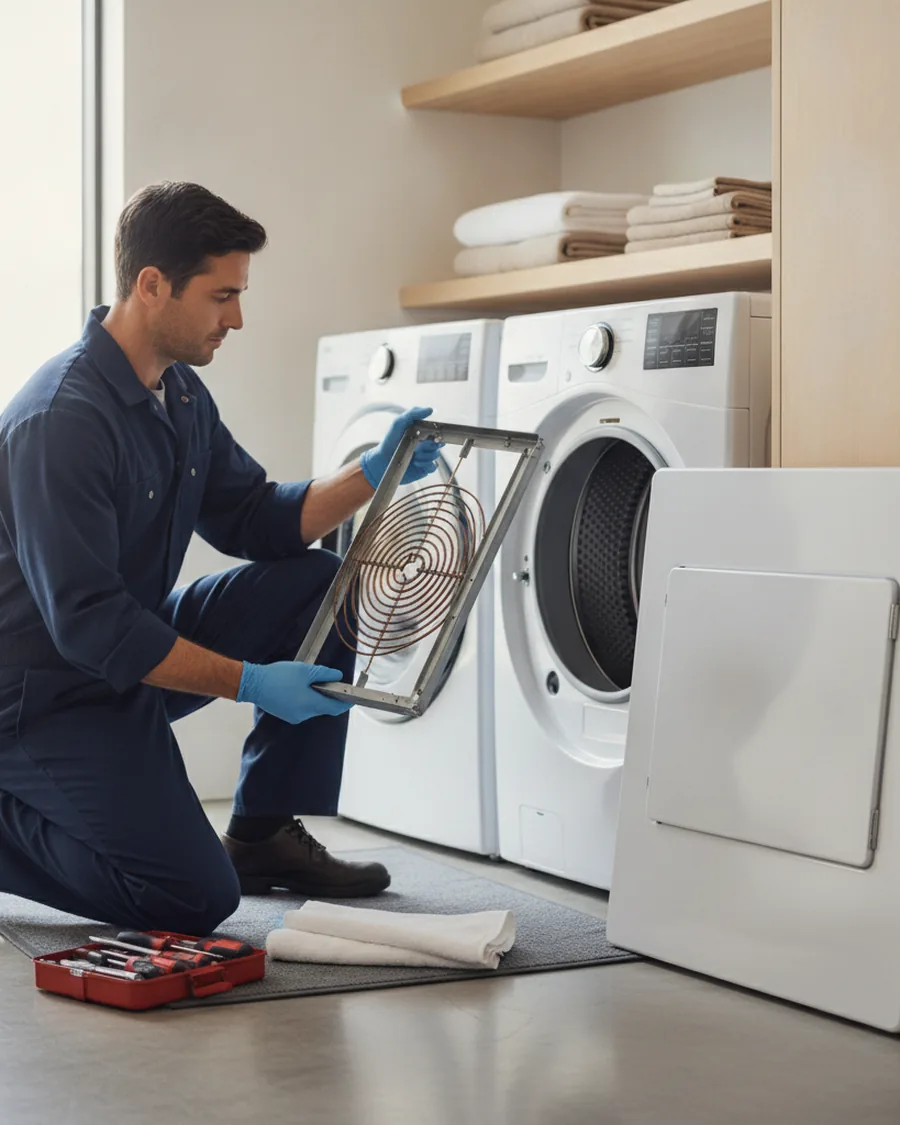
What a dryer is telling you.
Runs, tumbles, no heat
On an electric dryer this is the heating element, the thermal fuse, the high limit thermostat or the cycling thermostat, in roughly that order. On a gas dryer it is the igniter, the gas valve coils or the flame sensor: the igniter glows, the valve never opens, the burner never lights. A blown thermal fuse is a symptom as much as a fault, because it blows when the dryer overheats, and a dryer overheats when it cannot exhaust.
Takes two cycles, clothes come out damp and hot
Airflow. The vent run behind the wall, up through the roof or across a long crawl space is restricted, the lint trap housing is packed, or the blower wheel is loose. The dryer makes heat and cannot get rid of the moisture, so it runs long, cooks the clothes and stresses every part in the heat circuit. Fixing the vent fixes the dryer, and it removes a real fire risk.
Squeal, thump, scrape or no tumble
A squeal that starts a few minutes into the cycle is an idler pulley or a drum roller with a dry bearing. A thump on each rotation is a flat spot on a roller or a damaged belt. A scrape is a drum glide or a bearing letting the drum ride on the cabinet. A motor that hums and will not turn the drum has a broken belt or a seized roller. All of these are single visit repairs.
What we repair on dryers.
Gas, electric, stacked, compact and heat pump, every major brand.
- Heating elements, thermal fuses, high limit and cycling thermostats
- Gas igniters, gas valve coils, flame sensors and burner assemblies
- Drum rollers, idler pulleys, belts, glides, bearings and felt seals
- Drive motors, blower wheels and blower housings
- Door switches, start switches, belt switches and moisture sensors
- Control boards, timers, user interfaces and wiring harnesses
- Heat pump dryer compressors, evaporators, pumps and filters
- Dryer vent inspection, cleaning and repair of the run behind the machine
What dryer repair costs in California.
| Typical job | What usually causes it | Typical range |
|---|---|---|
| Runs but no heat | Thermal fuse, heating element, igniter or a blocked vent | $140 to $380 |
| Takes two cycles to dry | Restricted vent run, cycling thermostat or a weak element | $140 to $380 |
| Squeal, thump or scrape | Drum rollers, idler pulley, belt or glides | $140 to $380 |
| Will not start | Door switch, start switch, thermal fuse or a belt switch | $140 to $380 |
| Stops mid cycle | Moisture sensor, an overheating motor or a control fault | $140 to $380 |
The diagnostic visit is $89. The whole repair is quoted in writing before any work, you approve it first, and the fee is credited to the job when you go ahead.
A typical dryer repair, such as a heating element, a thermal fuse and thermostat set, an igniter, a set of rollers and a belt, a door switch or a moisture sensor, lands between $140 and $380 for parts and labor after the diagnostic fee is applied. A vent cleaning on the run behind the dryer is quoted on the day, based on what the run looks like, and it is often the whole fix.
The diagnostic visit is $89, credited to the repair when you go ahead. You approve the full price in writing before any work starts, and a return trip to fit an ordered part is inside that number.
Repair it, or replace it?
Dryers are simple machines with few expensive parts, so a dryer of almost any age with a single fault is a repair. An element, a fuse, an igniter, a belt, a roller kit or a motor costs a fraction of a new machine, and a fifteen year old gas dryer with a new igniter will run for years. A stacked laundry center is a repair past that age too, because the replacement is a matched pair and an installer.
Replacement is the right call when a drum has cracked, when the cabinet has rusted through, when the control board has failed on a model whose boards are no longer made, or when a heat pump dryer has lost its sealed system past the age where that makes sense. We tell you which one you have before you spend anything past the diagnostic fee.
What people ask before they call.
The motor and the heat circuit are separate, which is why a dryer can tumble happily and dry nothing. On an electric dryer the heat comes from a coil element, protected by a thermal fuse, a high limit thermostat and a cycling thermostat. Any one of them opening leaves the drum turning cold. The element itself often fails visibly, with a broken coil, and the thermal fuse is the most common of the rest. On a gas dryer the sequence is an igniter that glows, a flame sensor that sees it, and gas valve coils that open the valve. When the igniter glows and the burner never lights, the coils are the usual suspect; when nothing glows, it is the igniter or the sensor.
A thermal fuse deserves a second look, because it does not fail on its own. It opens when the dryer overheats, and a dryer overheats when it cannot exhaust. A vent run blocked with lint, a crushed duct behind the machine or a roof cap stuck shut will blow a fuse, and replacing the fuse without clearing the vent puts you back where you started in a month.
So a good technician checks the airflow first, then tests the heat circuit part by part. Most of these parts ride on the truck and the repair is a single visit. If your dryer is running cold, stop using it, because a dryer that has overheated once will do it again. Call (888) 482-7007 and tell us gas or electric.
Dryers are simple machines and the parts are inexpensive, so dryer repairs sit toward the affordable end of what we do. A heating element, a thermal fuse with the thermostat that should be replaced alongside it, a gas igniter, a set of gas valve coils, a drum roller kit with a belt, an idler pulley, a door switch or a moisture sensor each lands between $140 and $380 for parts and labor after the diagnostic fee is applied.
The two jobs that reach the top of that range are a drive motor and a control board on a newer machine with a touch display. A blower wheel that has come loose on the motor shaft, or a drum that has cracked at the seam, is quoted on the day. A vent cleaning of the run behind the dryer, which turns out to be the whole fix on a good share of no-heat and long-cycle calls, is quoted once we see the run.
The visit begins with a $89 diagnostic, which pays for a licensed technician to find the fault and check the airflow. You get the complete price in writing before any work starts, you approve it, and the diagnostic fee is credited toward the repair. There is no hourly rate, and a return trip to fit a part we had to order is inside the quote, not on top of it.
Repair, in most cases, and by a wider margin than for any other laundry appliance. A dryer has a motor, a heat source, a belt, a few rollers and a handful of switches and thermostats, all of which are cheap to replace, and the drum and cabinet do not wear out. A fifteen year old gas dryer with a new igniter is a good dryer with years ahead. That is why a dryer of almost any age with a single fault is a repair.
The exceptions are specific. A drum that has cracked, a cabinet that has rusted through in a damp garage, a motor on a budget machine that is also showing roller and belt wear, or a control board that is no longer made for the model each tip the answer toward replacement. A heat pump dryer that has lost its sealed system past ten years is another. A stacked laundry center is the opposite case: the replacement is a matched pair plus an installer, so it is worth more repair.
The one thing that should not drive the decision is the vent. A dryer that takes two cycles and runs hot with a restricted vent is not a worn out dryer, and a new one on the same vent will behave the same way. We check the airflow before we quote anything. Call (888) 482-7007 with the age, gas or electric and the symptom, and we will give you a plain view.
Ten to thirteen years is typical, and dryers that are kept vented properly often go well past it, because the parts that wear are all replaceable and the parts that are not, the drum and the cabinet, do not wear. Gas dryers tend to outlast electric ones by a little, mostly because a gas burner is easier on the machine than an element cycling at full power. Compact ventless and heat pump dryers sit at the shorter end, having more to go wrong.
What actually shortens a dryer's life is heat it cannot get rid of. A vent run that is long, kinked, crushed behind the machine or packed with lint makes every cycle longer and hotter, and it cooks the thermostats, the motor and the element years early. Most of the dryers we replace parts on before their time have a blocked vent behind them. A lint screen that is never washed, so that fabric softener film blocks it, does the same thing more slowly.
The maintenance that adds years is almost free: clean the screen every load, wash it every few months, have the vent run cleaned every year or two, and pull the dryer out once a year to clear lint from behind and under it. A dryer inside its expected life with one fault is a repair, and even one past it usually is, because the fix is cheap. If yours is running long and hot, call (888) 482-7007 before the fuse blows.
No heat leads, and it is a heat circuit fault or a vent restriction, or both at once. A blown thermal fuse, a failed heating element, a gas igniter that no longer glows, gas valve coils that have weakened with age and a cycling thermostat that sticks open are the parts. Behind a large share of them is a vent that could not clear the moist air, so the dryer overheated until something gave.
Long cycles are next, and they are the same vent problem caught earlier. Clothes come out damp and hot after a full cycle, the top of the dryer is warm to the touch, and the lint screen housing is packed. On newer machines a vent restriction shows up as a check-vent light or a code, and the fix is the run behind the wall, not the dryer.
Noise makes up most of the rest. A squeal that starts a few minutes in is a dry idler pulley or drum roller bearing, a thump on each turn is a flat roller or a damaged belt, and a scrape is a drum glide that has worn through. A dryer that hums and will not turn has a broken belt. Then a smaller group: a door switch that stops the machine starting, a start switch, a moisture sensor coated in softener that ends cycles early, and control faults. Almost all of it is one visit with parts from the truck. Call (888) 482-7007 with the symptom and we can usually name the part before we arrive.
Every region of California, one number.
Nine dispatch regions and 217 city pages. The technician who comes out works the area you live in.
The luxury platforms we repair for this job.
Assigned to a technician who has worked the platform, with the factory service literature open.
Dryer not heating? Do not keep running it.
A dryer that runs hot and long with a blocked vent is a fire risk, not just an inconvenience. Call (888) 482-7007, tell us gas or electric and the symptom, and we will get a technician out, usually the same day in the metros.