Appliance Repair in Lancaster, CA
The Lancaster climate runs very hot summer, cold winter, and a garage refrigerator or freezer here spends the summer in conditions it was never rated for. Our technicians know the difference between a failing compressor and one that is simply overwhelmed, and we tell you which before you pay for a repair.
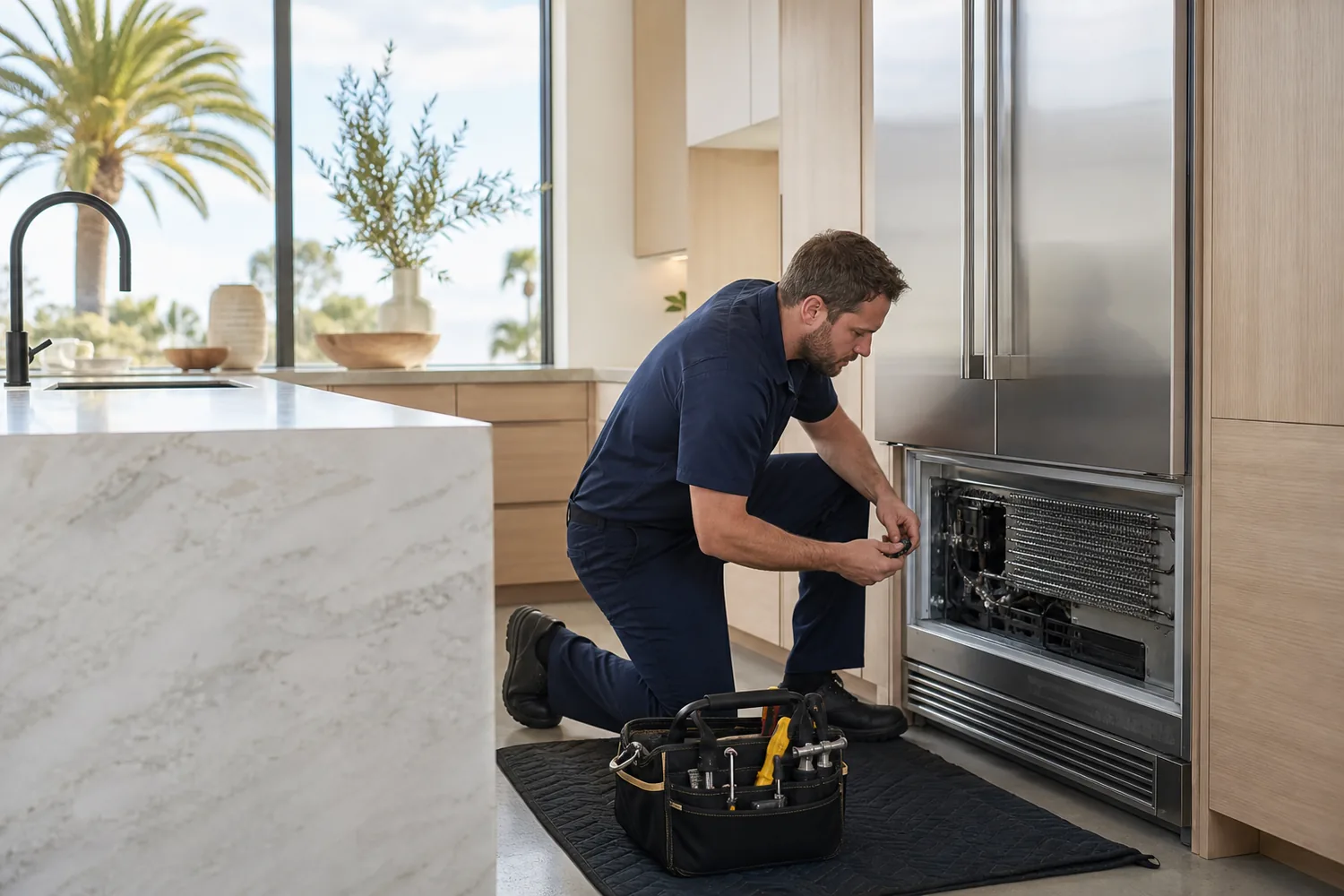
All of Lancaster, covered.
Lancaster is a city of about 167,426 people in Los Angeles County. Around 70.3 percent of homes are detached houses and the median home was built in 1986, so most of what we see is a full-size kitchen and a garage or side-yard laundry. Dispatch covers 3 delivery ZIP codes here, and the technician who comes out works Los Angeles County every day. One technician group covers all of Lancaster; the ZIP codes below are the delivery areas we serve.
Not sure if we reach you?
Tell us the cross street. We will tell you the time window in about ten seconds.
Every major appliance, freestanding or built in.
Refrigerator & freezer
Not cooling, leaking, loud compressor, warm freezer. Garage units get checked for heat load first.
Washer
Will not spin, will not drain, leaking or walking. Front load, top load and stacked.
Dryer
No heat, endless cycles, thermal shutdown. Gas and electric, plus the vent run that causes half the calls.
Dishwasher
Not draining, not cleaning, leaking, stuck mid cycle. Panel-ready and integrated units included.
Oven, range & cooktop
Burners that will not light, uneven baking, dead board. Gas, electric, induction and dual fuel.
Ice maker
No ice, slow ice, small hollow cubes, flooded bin. Under counter and built-in units too.
Microwave & disposal
Built-in, drawer and over-range microwaves, jammed disposals, vent hoods and warming drawers.
SPECIALISTBuilt-in & luxury
Sub-Zero, Viking, Thermador, Wolf, Miele and Dacor. Assigned to a technician who has worked the platform.
What Lancaster repairs actually cost.
Nobody else on this search result will show you a number before you call. Here is the honest range, and what moves it.
| Typical Lancaster job | What usually causes it | Typical range |
|---|---|---|
| Dishwasher not draining or not cleaning | A blocked sump, a tired drain pump or a failed inlet valve | $150 to $400 |
| Ice maker not producing | A failed fill valve, a frozen fill tube or a worn module | $150 to $380 |
| Refrigerator not cooling | Condenser fan, defrost system or a start relay | $180 to $480 |
| Dryer runs but will not heat | Element, thermal fuse or igniter | $140 to $380 |
| Washer will not drain | Drain pump, filter obstruction or the hose | $160 to $450 |
| Oven not heating evenly | Igniter, bake element or a calibration drift | $160 to $480 |
| Built-in refrigerator sealed system | Refrigerant charge, compressor or evaporator on a built-in | $800 to $2,200 |
One flat diagnostic fee of $89 gets a licensed technician to your door. The full repair is quoted before any work starts, you approve it first, and the diagnostic fee goes toward the job when you book the repair.
What people here ask us first.
Because most freezers are not rated for the temperature a Lancaster garage reaches. The climate here is very hot summer, cold winter, and once the air around the cabinet passes what the compressor was designed for, the unit runs continuously and still loses the interior. People read that as a failing compressor when the compressor is working exactly as built, in conditions it was never specified for. The newer stock helps slightly, with about 34.0 percent of homes predating 1980, but an attached garage still runs far hotter than the rooms next to it. Worth knowing before you pay for a repair: a garage-rated unit is built for this and a kitchen unit is not, so if the appliance is a standard indoor freezer living in a garage, the honest answer is sometimes that the appliance is wrong for the location rather than broken. We will tell you that on the visit.
Where the appliance sits on its age curve answers most of the question. Failures cluster at two points in a machine's life. Early ones, in the first year or so, are manufacturing faults and belong to the manufacturer's warranty. Late ones, past the appliance's expected life, arrive in groups: the pump goes, then the valve, then the seal, because everything wore together. The long middle stretch is where a single part fails on its own while the rest of the machine has years left, and that is where repair is overwhelmingly the right answer. A seven-year-old dryer with a failed heating element is not an old dryer with a problem; it is a sound dryer with one worn part.
So ask two questions. Is this the first significant fault, or the third this year? And is the machine inside the middle of its expected life, roughly years two through nine for most freestanding appliances, longer for built-in and premium units? First fault, middle of life: repair, almost without exception. Third fault, past the expected life: the machine is telling you something.
The technician's job is to place your appliance on that curve honestly and to quote the repair in writing after a $89 diagnostic visit that is credited to the job. If the curve says replace, you will hear it.
Whatever the fee is, it should be visible on the paperwork afterward, and that is a test worth applying. A fair invoice has three lines you can follow: the diagnostic fee, the repair with parts and labor shown separately, and the credit that takes the fee back off when you went ahead. If the credit is missing, or the parts and labor are lumped into a single figure so the fee could be hiding inside it, ask. California's rules for repair businesses call for an itemized invoice, and you are entitled to have the replaced parts returned to you on request, which confirms the part billed was the part changed.
Our fee is $89, quoted on the phone; it covers the visit, a diagnosis with test equipment and a written price for the complete repair, and when you book the repair it appears on the invoice as a credit against the job. The invoice itemizes parts and labor.
So the answer to how much a diagnostic fee should be has a second half: it should be whatever you were told, once, and you should be able to see exactly where it went. A fee that cannot be traced on the invoice was not credited, whatever the phone call said.
They can, and the diagnosis is often easier than on a gas or radiant cooktop, because induction units report their own faults. Most models display an error code when something is wrong, and the code narrows the problem to a family: a pan not detected, overheating, a supply voltage problem, a communication fault between the controls and the power board, or a failed zone. A technician familiar with the brand reads the code, confirms it with measurements, and knows which part to bring. Without the code, the same technician tests the power board's outputs to each coil, the cooling fan, the temperature sensors and the touch controls in turn.
The common repairs are the power board, the fan and the control panel, in that order, with the coils and the glass less often. What you can check yourself before calling: that a magnet sticks to the pan you are using, that the breaker has not tripped, and that the vents under the cooktop are not blocked by something stored in the cabinet below, which causes overheating shutdowns.
Our diagnostic visit is a flat $89, and induction work goes to technicians who service it regularly. The full repair is quoted in writing before any work, and the fee is credited to the repair if you proceed.
More than any other dryer, a heat pump dryer lasts as long as it is looked after, because its life is set by a compressor that suffers directly from neglect. The maintenance is short: empty the lint screen every load, clean the secondary filter every few loads, clean the heat exchanger monthly with regular use, and if the unit drains to a reservoir, empty it. Done, airflow stays high, the compressor runs cool, and ten to thirteen years or more is a fair expectation. Skipped, the exchanger clogs, drying times stretch, the dryer overheats and throws codes, and the compressor ages fast; a heat pump dryer treated like a vented one can lose years.
The rest of the machine ages like any dryer. Belts, rollers, pulleys and door switches wear and are cheap to replace. The condensate pump and the fans are moderate. The electronics last as long as they are kept cool and away from surges.
If a heat pump dryer has slowed down, the first step is cleaning, and the second is a diagnosis, because a dryer that has been running hot for months may have damage that cleaning will not undo. The visit is $89, flat, and it counts toward the repair if you decide to go ahead.
We also cover the rest of Los Angeles County.
Appliance down in Lancaster?
One call reaches a licensed technician near you. Same-day slots go fast.