Appliance Repair in Hesperia, CA
Heat is the local condition in Hesperia. Refrigerators run constantly, freezers in the garage lose the fight by August, and dryers in an unvented laundry room shut down on thermal overload. We diagnose for it and quote before any work.
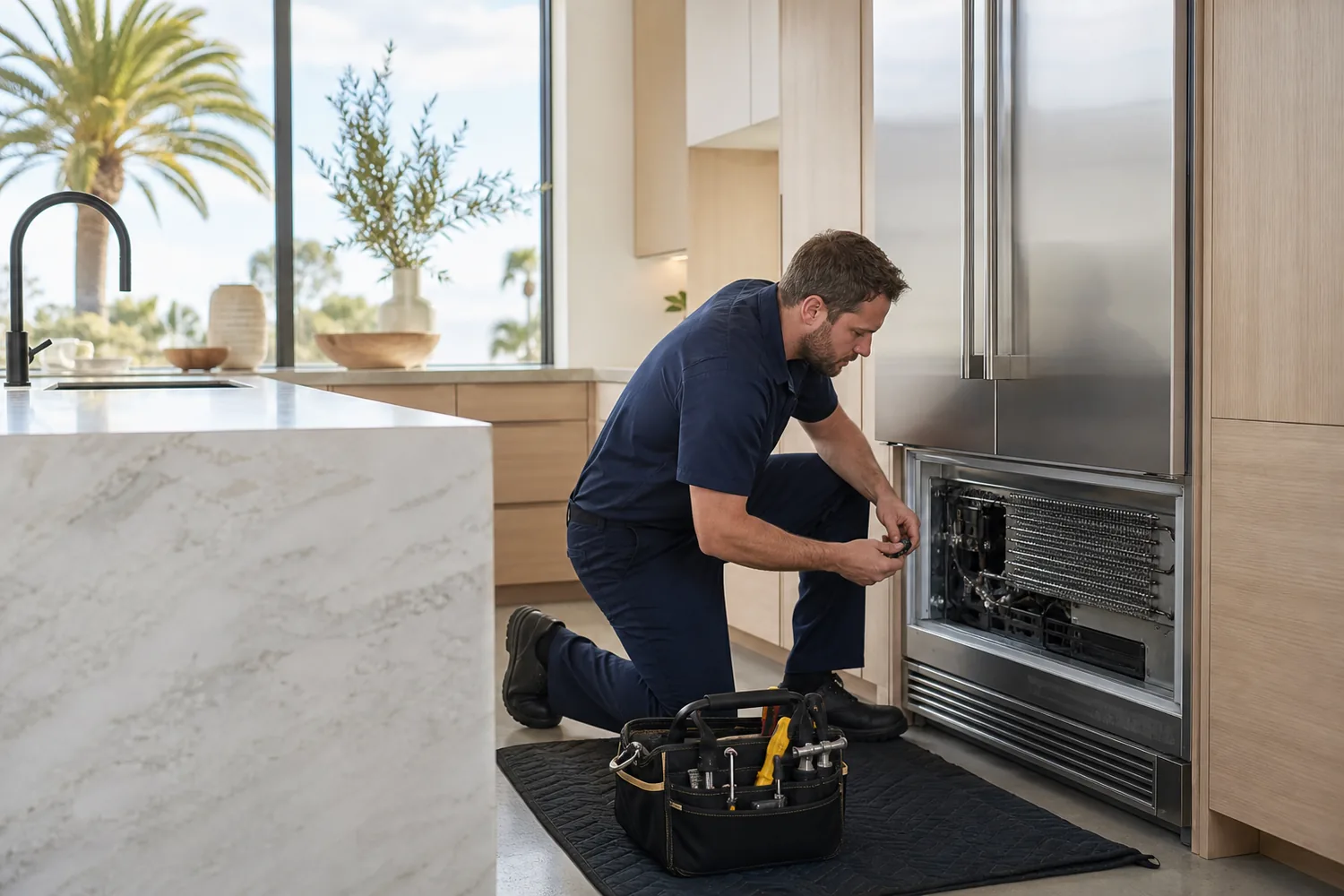
All of Hesperia, covered.
Hesperia is a city of about 101,836 people in San Bernardino County. Around 82.2 percent of homes are detached houses and the median home was built in 1988, so most of what we see is a full-size kitchen and a garage or side-yard laundry. Dispatch covers 3 delivery ZIP codes here, and the technician who comes out works Inland Empire every day. One technician group covers all of Hesperia; the ZIP codes below are the delivery areas we serve.
Not sure if we reach you?
Tell us the cross street. We will tell you the time window in about ten seconds.
Every major appliance, freestanding or built in.
Refrigerator & freezer
Not cooling, leaking, loud compressor, warm freezer. Garage units get checked for heat load first.
Washer
Will not spin, will not drain, leaking or walking. Front load, top load and stacked.
Dryer
No heat, endless cycles, thermal shutdown. Gas and electric, plus the vent run that causes half the calls.
Dishwasher
Not draining, not cleaning, leaking, stuck mid cycle. Panel-ready and integrated units included.
Oven, range & cooktop
Burners that will not light, uneven baking, dead board. Gas, electric, induction and dual fuel.
Ice maker
No ice, slow ice, small hollow cubes, flooded bin. Under counter and built-in units too.
Microwave & disposal
Built-in, drawer and over-range microwaves, jammed disposals, vent hoods and warming drawers.
SPECIALISTBuilt-in & luxury
Sub-Zero, Viking, Thermador, Wolf, Miele and Dacor. Assigned to a technician who has worked the platform.
What Hesperia repairs actually cost.
Nobody else on this search result will show you a number before you call. Here is the honest range, and what moves it.
| Typical Hesperia job | What usually causes it | Typical range |
|---|---|---|
| Dishwasher not draining or not cleaning | A blocked sump, a tired drain pump or a failed inlet valve | $150 to $400 |
| Ice maker not producing | A failed fill valve, a frozen fill tube or a worn module | $150 to $380 |
| Refrigerator not cooling | Condenser fan, defrost system or a start relay | $180 to $480 |
| Dryer runs but will not heat | Element, thermal fuse or igniter | $140 to $380 |
| Washer will not drain | Drain pump, filter obstruction or the hose | $160 to $450 |
| Oven not heating evenly | Igniter, bake element or a calibration drift | $160 to $480 |
| Built-in refrigerator sealed system | Refrigerant charge, compressor or evaporator on a built-in | $800 to $2,200 |
One flat diagnostic fee of $89 gets a licensed technician to your door. The full repair is quoted before any work starts, you approve it first, and the diagnostic fee goes toward the job when you book the repair.
What people here ask us first.
Because most freezers are not rated for the temperature a Hesperia garage reaches. The climate here is very hot summer, cold winter, and once the air around the cabinet passes what the compressor was designed for, the unit runs continuously and still loses the interior. People read that as a failing compressor when the compressor is working exactly as built, in conditions it was never specified for. The newer stock helps slightly, with about 30.0 percent of homes predating 1980, but an attached garage still runs far hotter than the rooms next to it. Worth knowing before you pay for a repair: a garage-rated unit is built for this and a kitchen unit is not, so if the appliance is a standard indoor freezer living in a garage, the honest answer is sometimes that the appliance is wrong for the location rather than broken. We will tell you that on the visit.
A built-in cooktop is worth repairing more often than a range, because replacing it is more trouble than it looks. A cooktop set into a counter was cut for that exact model. A replacement has to match the cutout, or the countertop has to be recut, which on stone is a fabricator's job. A gas cooktop needs its connection and shutoff checked; an electric or induction cooktop needs the right circuit, and a change of type, gas to induction for instance, is an electrical project. And the unit was chosen to match the oven and the kitchen, so a like-for-like replacement may not exist.
Against that, nearly every cooktop repair is modest: igniters, spark modules, elements, receptacles, switches, radiant elements, cooling fans, touch controls. Even the expensive repairs, a glass top or an induction power board, are usually worth doing on a built-in cooktop, because the alternative is an appliance plus the work to fit it.
Our diagnostic visit is a flat $89, credited to the repair if you go ahead, and built-in cooktop work is quoted by a technician who knows the platform. The full repair is priced in writing before anything is touched.
For a refrigerator ice maker, yes, as long as the refrigerator itself is not near the end of its life. The repair is one of three things, and none of them is expensive. If the water inlet valve or the fill tube has scaled or frozen, which is the most common cause, the repair is a valve or a tube. If the module has failed, it is replaced as a unit, a moderate part and a short job. If the freezer is not cold enough for the ice maker to cycle, the repair is to the refrigerator's defrost or airflow, and the ice maker comes back on its own. Against the cost of living without ice or replacing a refrigerator that is otherwise fine, any of those is worth doing.
The order matters. A technician who replaces the module without checking the water flow may be replacing a working part, so the fill and the pressure get checked first. And a refrigerator whose freezer is running warm has a refrigerator problem that a new ice maker will not fix.
The case for not repairing is narrow: a refrigerator so old or so far gone that the ice maker is one fault among several. Our diagnostic visit is a flat $89, credited to the repair when you go ahead, and the technician will tell you which case you have.
The visible deposits on the outside are a different job from the scale inside, and using the wrong cleaner on them does more harm than the scale. On a glass or ceramic cooktop, the white haze that appears after a boil-over is mineral baked onto the surface; use a cooktop cleaner and the flat scraper made for the purpose, never an abrasive pad, which leaves scratches that catch every future spill. On stainless doors and fronts, a little diluted white vinegar on a cloth followed by a dry wipe with the grain takes off spotting; do not let it sit, and keep it away from any stone countertop it meets, because acid etches stone. Refrigerator water and ice dispenser nozzles crust up; a cotton swab dipped in vinegar or citric acid solution clears them, and rinse afterward because the water runs into your glass. On aluminum trim or any anodized part, skip acids entirely; they dull the finish.
Two signs that the outside crust points to a problem inside. A dispenser that dribbles or a stream that has thinned means the tube or valve behind it is scaling. A cooktop or dishwasher door with white streaks that return within days means the water is depositing faster than cleaning can keep up, and a softener or a filter is the fix rather than a cloth.
Where the scale is inside a valve, a tube or an element, it is replaced rather than cleaned, and that is a short repair.
We also cover the rest of San Bernardino County.
Appliance down in Hesperia?
One call reaches a licensed technician near you. Same-day slots go fast.