Appliance Repair in Moreno Valley, CA
One number for every major appliance in Moreno Valley. A technician who lives in the area, common parts on the truck, and a repair price you approve before a single panel comes off.
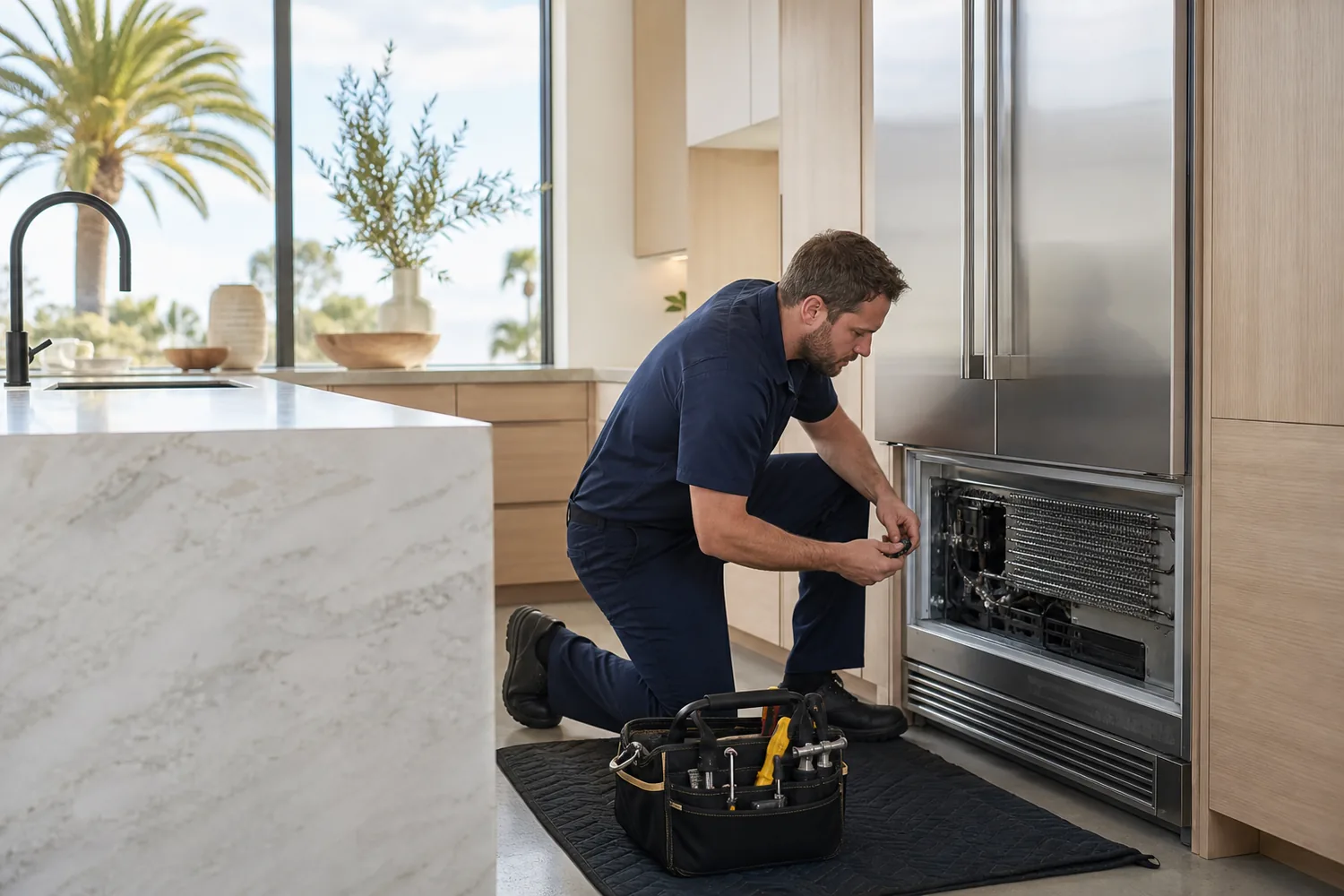
Every Moreno Valley ZIP code, one number.
Moreno Valley is a city of about 213,919 people in Riverside County. Around 77.9 percent of homes are detached houses and the median home was built in 1988, so most of what we see is a full-size kitchen and a garage or side-yard laundry. Dispatch covers 4 delivery ZIP codes here, and the technician who comes out works Inland Empire every day. One technician group covers all of Moreno Valley; the ZIP codes below are the delivery areas we serve.
Not sure if we reach you?
Tell us the cross street. We will tell you the time window in about ten seconds.
Every major appliance, freestanding or built in.
Refrigerator & freezer
Not cooling, leaking, loud compressor, warm freezer. Freestanding, counter depth and built-in columns.
Washer
Will not spin, will not drain, leaking or walking. Front load, top load and stacked.
Dryer
No heat, endless cycles, thermal shutdown. Gas and electric, plus the vent run that causes half the calls.
Dishwasher
Not draining, not cleaning, leaking, stuck mid cycle. Panel-ready and integrated units included.
Oven, range & cooktop
Burners that will not light, uneven baking, dead board. Gas, electric, induction and dual fuel.
Ice maker
No ice, slow ice, small hollow cubes, flooded bin. Under counter and built-in units too.
Microwave & disposal
Built-in, drawer and over-range microwaves, jammed disposals, vent hoods and warming drawers.
SPECIALISTBuilt-in & luxury
Sub-Zero, Viking, Thermador, Wolf, Miele and Dacor. Assigned to a technician who has worked the platform.
What Moreno Valley repairs actually cost.
Nobody else on this search result will show you a number before you call. Here is the honest range, and what moves it.
| Typical Moreno Valley job | What usually causes it | Typical range |
|---|---|---|
| Dishwasher not draining or not cleaning | A blocked sump, a tired drain pump or a failed inlet valve | $150 to $400 |
| Ice maker not producing | A failed fill valve, a frozen fill tube or a worn module | $150 to $380 |
| Refrigerator not cooling | Condenser fan, defrost system or a start relay | $180 to $480 |
| Dryer runs but will not heat | Element, thermal fuse or igniter | $140 to $380 |
| Washer will not drain | Drain pump, filter obstruction or the hose | $160 to $450 |
| Oven not heating evenly | Igniter, bake element or a calibration drift | $160 to $480 |
| Built-in refrigerator sealed system | Refrigerant charge, compressor or evaporator on a built-in | $800 to $2,200 |
One flat diagnostic fee of $89 gets a licensed technician to your door. The full repair is quoted before any work starts, you approve it first, and the diagnostic fee goes toward the job when you book the repair.
What people here ask us first.
After heat problems, noise and tumbling problems are the most common, and they are the cheapest category of dryer repair. A dryer that runs but the drum does not turn has almost always broken its drive belt, a simple rubber belt that stretches and snaps after years of use. A loud thumping that follows the drum around is worn drum rollers, the small wheels the drum rides on. A squeal or a scraping is the idler pulley that keeps the belt tight, or the drum glides at the front of the drum, or a worn rear drum bearing. A rattle is often a coin or a bra wire that has found its way into the blower.
Every one of those is an inexpensive part and a short job, and it is worth doing early. A dryer run for months on worn rollers or a failing pulley eventually wears the drum itself or the motor, and those are the expensive repairs on a dryer.
Our diagnostic visit is a flat $89, credited to the repair if you go ahead, and the technician carries belts, rollers and pulleys for the common dryers, so most of these are finished on the first visit.
Labor for appliance repair in California costs more than in most of the country, and the reasons are structural rather than greed. Technicians here earn more, insurance and vehicle costs are higher, fuel across a large metro adds up, and a legitimate shop carries liability coverage, trained technicians and a parts inventory on every truck. A quoted hourly rate from a properly run California shop reflects all of that. When you see a rate that seems too low, it usually means one of those things is missing, and the missing one is often the coverage that protects you if the repair goes wrong.
So the question is less "what is the rate" and more "what am I getting for it." A licensed, insured technician who arrives with the common parts for your appliance, diagnoses with a meter rather than a guess, and stands behind the work with a parts and labor warranty is worth a different amount than someone with a screwdriver and a website.
We do not bill by the hour. You pay a flat $89 diagnostic fee, get a firm quote for the full repair before any work starts, and the fee is applied to the job when you go ahead. That structure exists because an hourly clock rewards slow work, and a flat quote rewards getting it right the first time.
A washing machine typically lasts ten to thirteen years, with top loaders running a little longer on average than front loaders. What ends a washer is one of three things. On a front loader it is most often the drum bearings, which fail from the back of the sealed tub and cost enough to replace on an older machine that a new washer makes more sense. On either type it can be the outer tub cracking or the tub seal failing, which is the same job. And on modern machines it can be a control board that is no longer available. Everything else that wears, pumps, valves, locks, belts, gaskets, suspension, is replaced along the way at modest cost, and a washer that has needed a pump at year six is not near its end because of it.
Two factors shorten a washer's life in California. Hard water scales the inlet valve and wears the seals, so machines in hard-water cities lean toward the low end unless the water is softened. And detergent overdosing, which people do to compensate for hard water, leaves residue that holds moisture against the seals and the boot.
The habits that extend it are simple: dose detergent for the water, leave a front loader's door ajar between loads, clean the pump filter, and do not overload the drum.
While you work on getting it cold again, avoid the mistakes that turn a cheap fault into an expensive one. Never chip at ice with a knife, a screwdriver or an ice pick; the evaporator coil sits behind or under that ice, its aluminum tubing punctures easily, and a punctured evaporator is a sealed-system repair, the costliest on the appliance and often the end of it. Let ice melt on its own with the door open and towels down, or hasten it with bowls of warm water, never with a heat gun or a hair dryer held close to plastic liners and tubing. Do not turn the control to its coldest setting in the hope of forcing it; on a refrigerator-freezer that over-cools the fresh-food side and does nothing for the fault. Do not keep opening the door to check; each opening loads warm, humid air onto a system that is already struggling. Do not put hot food in. And do not run a freezer that is clicking, buzzing or hot at the compressor for days while deciding; a compressor cycling on its overload protector is being damaged.
Do move the food to a cooler with ice, note what the freezer is doing and when it started, and call the same day. A freezer that warms is usually a small part: a relay, a fan, a defrost component, a gasket. Our diagnostic visit is $89, credited to the repair when you go ahead.
We also cover the rest of Riverside County.
Appliance down in Moreno Valley?
One call reaches a licensed technician near you. Same-day slots go fast.