Appliance Repair in Clovis, CA
The Clovis climate runs very hot, dry summer, and a garage refrigerator or freezer here spends the summer in conditions it was never rated for. Our technicians know the difference between a failing compressor and one that is simply overwhelmed, and we tell you which before you pay for a repair.
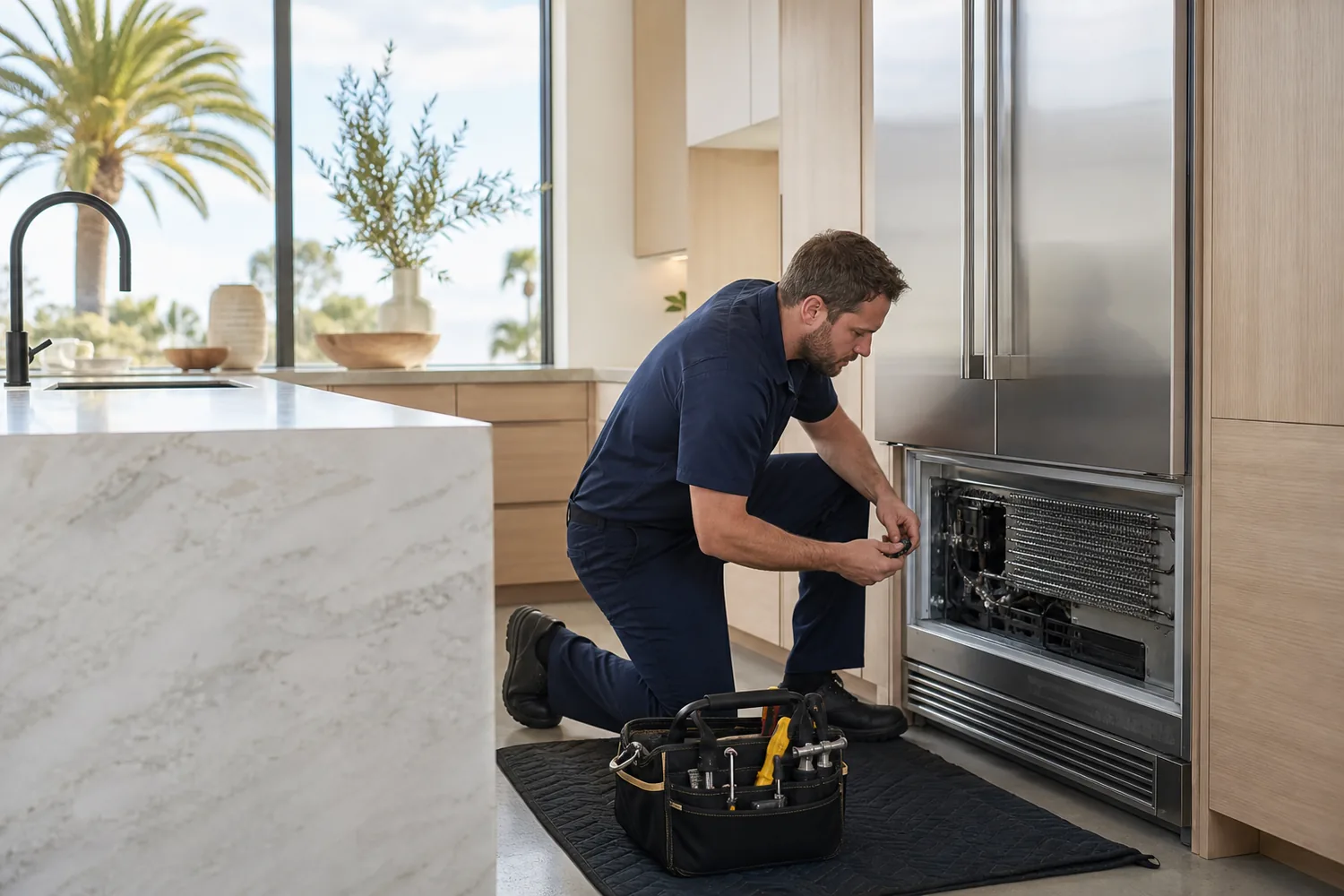
Why the same appliance fails sooner in Clovis.
Local conditions decide the diagnosis. These are the ones that show up on our invoices here.
Summer heat
The climate here runs very hot, dry summer, and a refrigerator or freezer in a Clovis garage spends months above the temperature its compressor was designed for. It runs continuously and still loses the interior. The newer stock helps slightly, with about 30.2 percent of homes predating 1980, but an attached garage still runs far hotter than the rooms next to it.
People read that as a failing compressor when the compressor is working exactly as built, in conditions it was never rated for.
Newer construction
21 percent of Clovis housing was built in 2010 or later, which in California means all-electric kitchens: induction cooktops and heat pump dryers where the previous generation had gas.
An induction cooktop that cuts out under load is usually a coil or a cooling fan, not the glass. A heat pump dryer that takes forever is usually a blocked evaporator, not a heating element, because it does not have one.
All of Clovis, covered.
Clovis is a city of about 127,993 people in Fresno County. Around 75.7 percent of homes are detached houses and the median home was built in 1995, so most of what we see is a full-size kitchen and a garage or side-yard laundry. We run Central Valley as one dispatch area, and Clovis sits inside it with 4 delivery ZIP codes. Tell us the cross street and we will give you a time window; every Clovis ZIP code below is inside our dispatch area.
Not sure if we reach you?
Tell us the cross street. We will tell you the time window in about ten seconds.
Every major appliance, freestanding or built in.
Refrigerator & freezer
Not cooling, leaking, loud compressor, warm freezer. Garage units get checked for heat load first.
Washer
Will not spin, will not drain, leaking or walking. Front load, top load and stacked.
Dryer
No heat, endless cycles, thermal shutdown. Heat pump models fail differently and we know how.
Dishwasher
Not draining, not cleaning, leaking, stuck mid cycle. Panel-ready and integrated units included.
Oven, range & cooktop
Burners that will not light, uneven baking, dead board. Gas, electric, induction and dual fuel.
Ice maker
No ice, slow ice, small hollow cubes, flooded bin. Under counter and built-in units too.
Microwave & disposal
Built-in, drawer and over-range microwaves, jammed disposals, vent hoods and warming drawers.
SPECIALISTBuilt-in & luxury
Sub-Zero, Viking, Thermador, Wolf, Miele and Dacor. Assigned to a technician who has worked the platform.
What Clovis repairs actually cost.
Nobody else on this search result will show you a number before you call. Here is the honest range, and what moves it.
| Typical Clovis job | What usually causes it | Typical range |
|---|---|---|
| Dishwasher not draining or not cleaning | A blocked sump, a tired drain pump or a failed inlet valve | $150 to $400 |
| Ice maker not producing | A failed fill valve, a frozen fill tube or a worn module | $150 to $380 |
| Refrigerator not cooling | Condenser fan, defrost system or a start relay | $180 to $480 |
| Dryer runs but will not heat | Element, thermal fuse or igniter | $140 to $380 |
| Washer will not drain | Drain pump, filter obstruction or the hose | $160 to $450 |
| Oven not heating evenly | Igniter, bake element or a calibration drift | $160 to $480 |
| Built-in refrigerator sealed system | Refrigerant charge, compressor or evaporator on a built-in | $800 to $2,200 |
One flat diagnostic fee of $89 gets a licensed technician to your door. The full repair is quoted before any work starts, you approve it first, and the diagnostic fee goes toward the job when you book the repair.
What people here ask us first.
Because most freezers are not rated for the temperature a Clovis garage reaches. The climate here is very hot, dry summer, and once the air around the cabinet passes what the compressor was designed for, the unit runs continuously and still loses the interior. People read that as a failing compressor when the compressor is working exactly as built, in conditions it was never specified for. The newer stock helps slightly, with about 30.2 percent of homes predating 1980, but an attached garage still runs far hotter than the rooms next to it. Worth knowing before you pay for a repair: a garage-rated unit is built for this and a kitchen unit is not, so if the appliance is a standard indoor freezer living in a garage, the honest answer is sometimes that the appliance is wrong for the location rather than broken. We will tell you that on the visit.
Yes, and they are worth getting to someone who has actually worked on them. 21 percent of Clovis housing was built in 2010 or later, which in California means a lot of all-electric kitchens where the previous generation had gas. Induction and heat pump appliances fail differently and get misdiagnosed by technicians who learned on gas. An induction cooktop that cuts out under load is usually a coil or a cooling fan, not the glass, and replacing the surface on that fault is an expensive way to fix nothing. A heat pump dryer that takes forever is usually a blocked evaporator rather than a heating element, because it does not have one. The tell-tale on the dryer is that it never gets hot to the touch but still dries, slowly. That is normal for a heat pump, right up until it is not. For context on what is going in locally, about 75.7 percent of homes here are detached single family.
An average repair cost misses the number that actually decides most refrigerator calls: what it costs not to fix it today. A refrigerator holds a few hundred dollars of food, and it holds it for roughly four hours once it stops cooling, a day or so for a full freezer. Beyond that the contents go with the fault. A same-day repair, which in most areas is what a call before noon gets you, competes not only with the price of a new refrigerator but with the price of a new refrigerator plus a week of eating out and everything that was in the old one.
Against that background, the actual repair range is modest. Completed repairs typically run $180 to $480, and the majority are at the lower half of that: relays, fans, defrost parts, gaskets, valves. The expensive exceptions are sealed-system repairs, and those are the cases where the technician will often recommend replacement on an older freestanding unit rather than quote the job.
Our diagnostic visit is a flat $89, seven days a week from 6am to midnight, and it is credited to the repair if you proceed. Move the food to a cooler with ice, call, and let the diagnosis decide. It is the one refrigerator decision that gets more expensive the longer it waits.
Think of the diagnostic fee as the price of a decision rather than the price of a visit. When an appliance fails, you are facing a choice between a repair, a replacement, or living with it, and the only way to make that choice well is to know what is actually wrong. A refrigerator that has stopped cooling could need a relay, which is trivial, or a compressor, which is not. Guessing wrong in either direction is expensive: you either replace a machine that needed a small part, or you pour money into one that was finished.
Our fee for that decision is $89. The technician confirms the fault with test equipment, quotes the full repair in writing, and if you go ahead the fee is credited to the job. If the answer is that the appliance should be replaced, you have spent the fee and saved the price of a pointless repair, which is a good outcome.
That is the standard we would apply to anyone's fee. It should be small enough to be worth paying for information, it should be credited when the information leads to a repair, and it should come with an honest verdict on whether the repair makes sense. A fee that meets those three tests is fair at most price points. One that fails them is expensive at any.
Heat. An induction cooktop is a power electronics unit sitting under a sheet of glass, and it makes a great deal of heat in the board and the coils that has to go somewhere. Every unit has a fan drawing air through the cabinet below to cool the electronics, and the most common fault pattern is that the cooling is not keeping up: the fan has failed, its intake has clogged with dust, or the cabinet under the cooktop has been packed with pots and pans right up against the vents. The cooktop responds by throttling power or shutting down with an overheating code, often twenty minutes into a high-power cook, which is exactly when it is most annoying.
The fix runs from clearing the cabinet and cleaning the intake, which costs nothing, to replacing the fan, which is a moderate repair. The reason to act on it is that sustained overheating is what eventually kills the power board, and the board is the expensive part.
Installation matters here. A cooktop dropped into a counter over a drawer stack with no ventilation clearance, which happens in remodels where the installer was not an appliance person, will run hot for its whole life. If yours shuts down on high power, that is the first thing to check. Our diagnostic visit is $89, applied to the repair if you proceed.
Appliance down in Clovis?
One call reaches a licensed technician near you. Same-day slots go fast.