Appliance Repair in Oakland, CA
Oakland has bay frontage, and salt carried off the bay is the reason a refrigerator here fails years earlier than the same model inland. Our technicians inspect the condenser and the board contacts first, because that is where the coastal fault usually is.
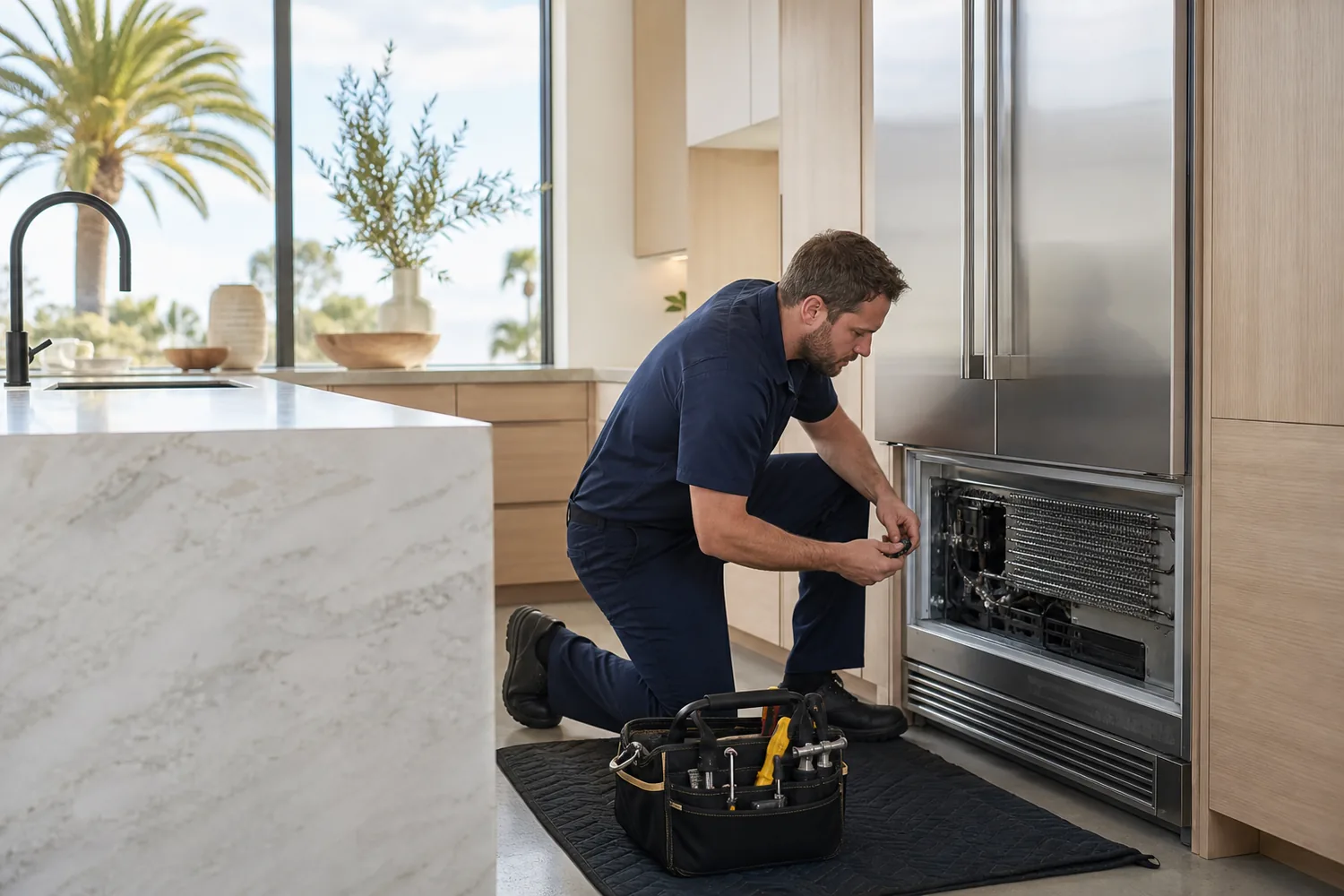
Why the same appliance fails sooner in Oakland.
Local conditions decide the diagnosis. These are the ones that show up on our invoices here.
Marine air
Oakland has bay frontage, so salt carried off the bay corrodes condenser coils, control board contacts and metal fasteners years earlier than a few miles inland. It is milder than the open coast but relentless. Age compounds exposure. Around 77.9 percent of homes here predate 1980, so a lot of the appliances we see have been breathing salt air for decades and the corrosion is cumulative.
Garage laundry rooms and utility spaces with a breeze through them get the worst of it.
Prewar and postwar stock
The median Oakland home dates to 1953, and 78 percent of the housing predates 1980. Kitchens of that era were built around appliances that are no longer standard sizes, on circuits that were never meant to carry a modern oven or a heat pump dryer.
We check the opening and the circuit before quoting, because finding out afterwards is how a repair turns into a remodel.
All of Oakland, covered.
Oakland is a city of about 443,554 people in Alameda County. Dispatch covers 18 delivery ZIP codes here, and the technician who comes out works San Francisco Bay Area every day. One technician group covers all of Oakland; the ZIP codes below are the delivery areas we serve.
Not sure if we reach you?
Tell us the cross street. We will tell you the time window in about ten seconds.
Every major appliance, freestanding or built in.
Refrigerator & freezer
Not cooling, leaking, loud compressor, warm freezer. Coastal units get the condenser checked first.
Washer
Will not spin, will not drain, leaking or walking. Front load, top load and stacked.
Dryer
No heat, endless cycles, thermal shutdown. Half the calls in older stock are the vent run, not the dryer.
Dishwasher
Not draining, not cleaning, leaking, stuck mid cycle. Panel-ready and integrated units included.
Oven, range & cooktop
Burners that will not light, uneven baking, dead board. Gas, electric, induction and dual fuel.
Ice maker
No ice, slow ice, small hollow cubes, flooded bin. Under counter and built-in units too.
Microwave & disposal
Built-in, drawer and over-range microwaves, jammed disposals, vent hoods and warming drawers.
SPECIALISTBuilt-in & luxury
Sub-Zero, Viking, Thermador, Wolf, Miele and Dacor. Assigned to a technician who has worked the platform.
What Oakland repairs actually cost.
Nobody else on this search result will show you a number before you call. Here is the honest range, and what moves it.
| Typical Oakland job | What usually causes it | Typical range |
|---|---|---|
| Dishwasher not draining or not cleaning | A blocked sump, a tired drain pump or a failed inlet valve | $150 to $400 |
| Ice maker not producing | A failed fill valve, a frozen fill tube or a worn module | $150 to $380 |
| Refrigerator not cooling | Condenser fan, defrost system, or a coastal board contact | $180 to $480 |
| Dryer runs but will not heat | Element or thermal fuse, and very often a blocked vent run | $140 to $380 |
| Washer will not drain | Drain pump, filter obstruction or the hose | $160 to $450 |
| Oven not heating evenly | Igniter, bake element or a calibration drift | $160 to $480 |
| Built-in refrigerator sealed system | Refrigerant charge, compressor or evaporator on a built-in | $800 to $2,200 |
One flat diagnostic fee of $89 gets a licensed technician to your door. The full repair is quoted before any work starts, you approve it first, and the diagnostic fee goes toward the job when you book the repair.
What people here ask us first.
Salt air, and it is the reason coastal work is genuinely different work. Oakland has bay frontage, so salt carried off the bay corrodes condenser coils, control board contacts and metal fasteners years earlier than it does a few miles inland. It is milder than the open coast but relentless. Garage laundry rooms and utility spaces with a breeze running through them are the worst case we see. Age compounds exposure. Around 77.9 percent of homes here predate 1980, so a lot of the appliances we see have been breathing salt air for decades and the corrosion is cumulative. Two things shape how fast it bites here: the local climate runs mild marine, little temperature swing, and about 41.6 percent of homes are detached, which is where the garage and side-yard installations are. So the order of the diagnostic changes. A refrigerator that is not cooling here gets its condenser and its board contacts inspected first, because that is where the fault usually is. The same symptom inland points somewhere else entirely. The tell-tale is a fridge that runs constantly with a condenser fan you can hear from the next room.
Fit and power, before anything mechanical. The median Oakland home dates to 1953, and 78 percent of the housing stock predates 1980, so a lot of kitchens here were built around appliances that are no longer standard sizes. A replacement that is nominally the same width can still foul the cabinet face, the counter overhang or the door swing. Older circuits are the other half of it. A kitchen wired for the appliances of that era often cannot carry what a modern oven or a heat pump dryer wants, and the symptom is not a dead appliance but an intermittent one that trips under load. Parts availability matters too, since a discontinued board on a well-built older unit can be the difference between a sensible repair and a replacement. We check the opening and the circuit before quoting, because finding out afterwards is how a repair turns into a remodel. It matters more here because about 41.6 percent of homes here are detached single family.
More than any other appliance component, an ice maker's life expectancy is set by the water it is given. On soft or filtered water, a refrigerator ice maker module can run eight years or more and an under-counter ice machine over a decade. On hard water with no filter, the same module can be struggling in two or three years and the same machine can be down to a fraction of its capacity in one. The reason is that ice makers have the narrowest water passages in the house, they pass water continuously, and every fill leaves minerals behind in the valve, the fill tube, the pump and, on clear-ice machines, the evaporator plate.
The practical steps are simple. Change the refrigerator's water filter on the schedule the manufacturer gives, not when the ice tastes odd. If the home has a softener, make sure the refrigerator line runs from the softened side. Descale an under-counter machine on the maker's schedule. And be aware that a reverse osmosis system, which gives excellent water, delivers it at low pressure that an ice maker's valve may not open properly against; a booster pump solves it.
Given good water, an ice maker is a long-lived part. Given hard water, it is the part that fails first. Diagnosis costs a flat $89, and that fee comes off any repair you go ahead with.
The warranty tells you something about the lifespan the maker expects, and it is worth reading before the cooktop is installed rather than after it fails. Most induction cooktops carry a year of full parts and labor coverage; some makers extend coverage on the electronics, the power board in particular, for several years beyond that, and a few premium brands go further. Register the unit at purchase, keep the receipt, and note the two periods, because a board failure inside an extended parts warranty is a labor charge rather than the expensive repair that otherwise defines an induction cooktop's end. An extended plan from a retailer is a separate decision: on a budget induction range it can be worth having since a board late in life is close to the unit's value, and on a premium built-in it usually is not, since the maker's support and the unit's build already carry it.
With or without coverage, the expected life is ten to fifteen years, decided by the electronics and how cool they have been kept.
When something fails, the first question is where the unit is in its warranty periods; the second is whether the board is still available; the third is the repair. Our diagnostic visit is $89, credited to the repair if you go ahead, and the technician asks the first two before quoting.
The honest downside is that the long-term record in American homes is still short. Heat pump dryers have been common in Europe for many years, but they only became mainstream here recently, so there is less history on how they age in a laundry room that runs several loads a day, in a hot garage, or without the filter cleaning they need. The component whose lifespan matters is the compressor, the same type of part that limits a refrigerator's life, and when it fails out of warranty the repair is expensive enough that replacement is often the answer.
Against that, the things that end conventional dryers do not apply. There is no heating element to burn out, no vent to clog and start a fire, no blast of heat cycling the thermostats thousands of times. The mechanical parts, the drum, the belt, the rollers and the motor, are the same as in any dryer and just as repairable.
So the tradeoff is a machine that costs more, dries slower, needs more upkeep and carries one expensive component, in exchange for much lower running cost, no vent, gentler drying and a good chance of a long life if it is kept clean. Our diagnostic visit is a flat $89, credited to any repair, and heat pump dryers go to technicians who service them regularly.
We also cover the rest of Alameda County.
Appliance down in Oakland?
One call reaches a licensed technician near you. Same-day slots go fast.